
LAW AND ORDER
Notes on Open Carry, Outlaws, Criminals, Cowboys, Homelands, and ICE


“America has been invaded by criminals and predators. We need YOU to get them out.”
ICE Recruitment Advertisment
“I’m not licking the boot. It’s my boot. I voted for it. I’m the one stomping.”
Tim Pool
Ronald Reagan was young man once. Before Iran Contra, before Reaganomics or the war on drugs, before tough on crime policies exploded prison populations, before welfare queen rhetoric helped strengthen the racist case against social welfare, before thousands were abandoned to a horrible gasping death from AIDS. He spent much of his younger years squinting into the sun in Hollywood film lots, pitched up against fake-aged saloon doors. His bread was the Western, where the dust was high and men like him pushed west into the wild and shining frontiers of America, raving with savages and black-hearted men of crime. The furthest reach of civilisation, as yet untamed by the law. He had a stetson and a horse and a gun - and sometimes a badge of office. An icon of rough justice. Neat-waisted women would beg him to keep safe, and he would press them into strange kissing shapes and tell them he had something on his mind, something of a higher order. Where the laxities of a thin and patchwork would-be state left room for a rough-and-tumble libertarian freedom, that freedom was - had to be, you understand - underwritten by good men, their fists, their sightlines, their guns. Later he left Hollywood, kept the hat.
“I seem to remember a famous country and western song warning mothers not to let their babies grow up to be cowboys… The song forgot to say that cowboys can sometimes grow up and be President.”
- RONALD REAGAN
X
Young Ronald - the ‘fat little dutchman’ as his father called him - whiled away an unremarkable suburban childhood, capped off by college football and a brief radio career before screen testing at Warner Brothers. The rest, unfortunately, was history. But on screen and on the world stage of his presidency he played the cowboy like he was born to it. In his second term he bought a 700-acre ranch and called it Heaven. The hat stayed.
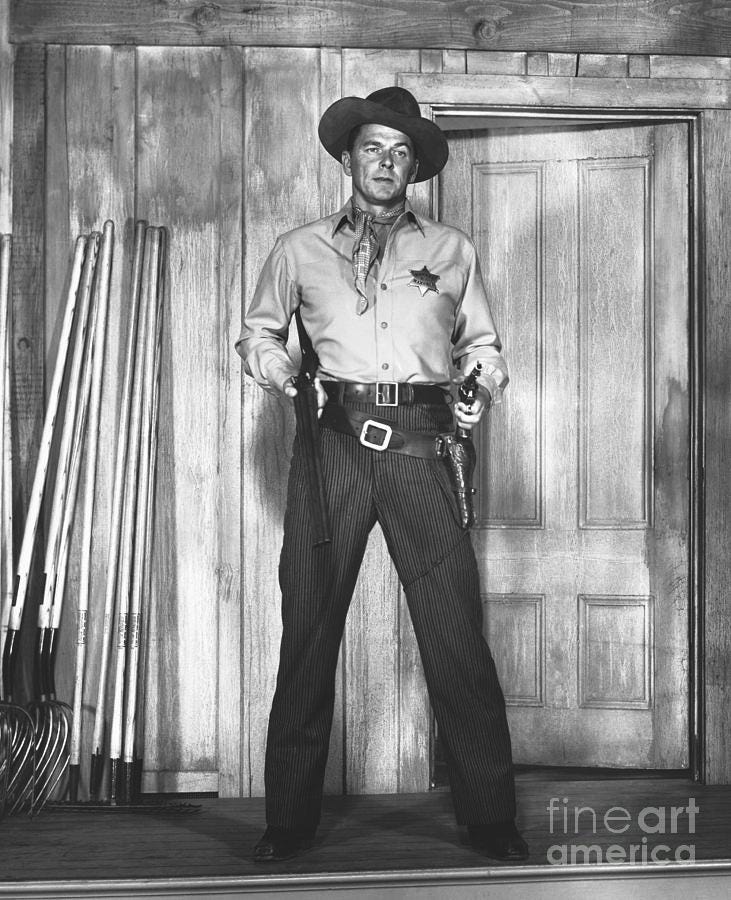
In Law and Order (1953), Reagan plays another stolid frontiersman named Frame Johnson, torn between the love of a good woman and the blunt unblinking policework it takes to keep her safe. He walks, so the film would have it, in the considerable bootprints of those real men of the west who kept the fires of the night watch lit, kept its flints sharpened. Wyatt Earp, Wild Bill Hicok, Buffalo Bill, the rest.
You know the legends. That these grandees of the Old West traded in derring do, in feats of heroism and bravery that always landed them on the side of right if not always on the side, technically speaking, of the law. If they fought you fought against the cruel and the savage, they fought because they had no other choice, they did so with beauty and skill. If they stole you did so for love and adventure and self-determination. Sometimes they commanded the law, sometimes they evaded it. Easy. Of course, we are supposed to know the legends; they were notorious self-publicists and self-mythologisers even in their own time.
X
An honest appraisal of the grubby work of racial terror that it took to forge the Homeland does not make for favourable television. The West of slavetaking, genocide, land clearances. All these look a lot less like a life of honest-hearted, rough-palmed toil on the fringes of man’s capacity for dreaming. Something much more prosaic: the consolidation of the colony, the expansion of the mechanisms of accumulation, the steady regularisation of land and life by power.
X
Some questions: Do outlaw narratives whitewash histories of frontier racial terror? Do they give us consumers permission to indulge in the fantasies of domination?
Either way - they help sustain the racial structure our imaginaries of freedom.
X
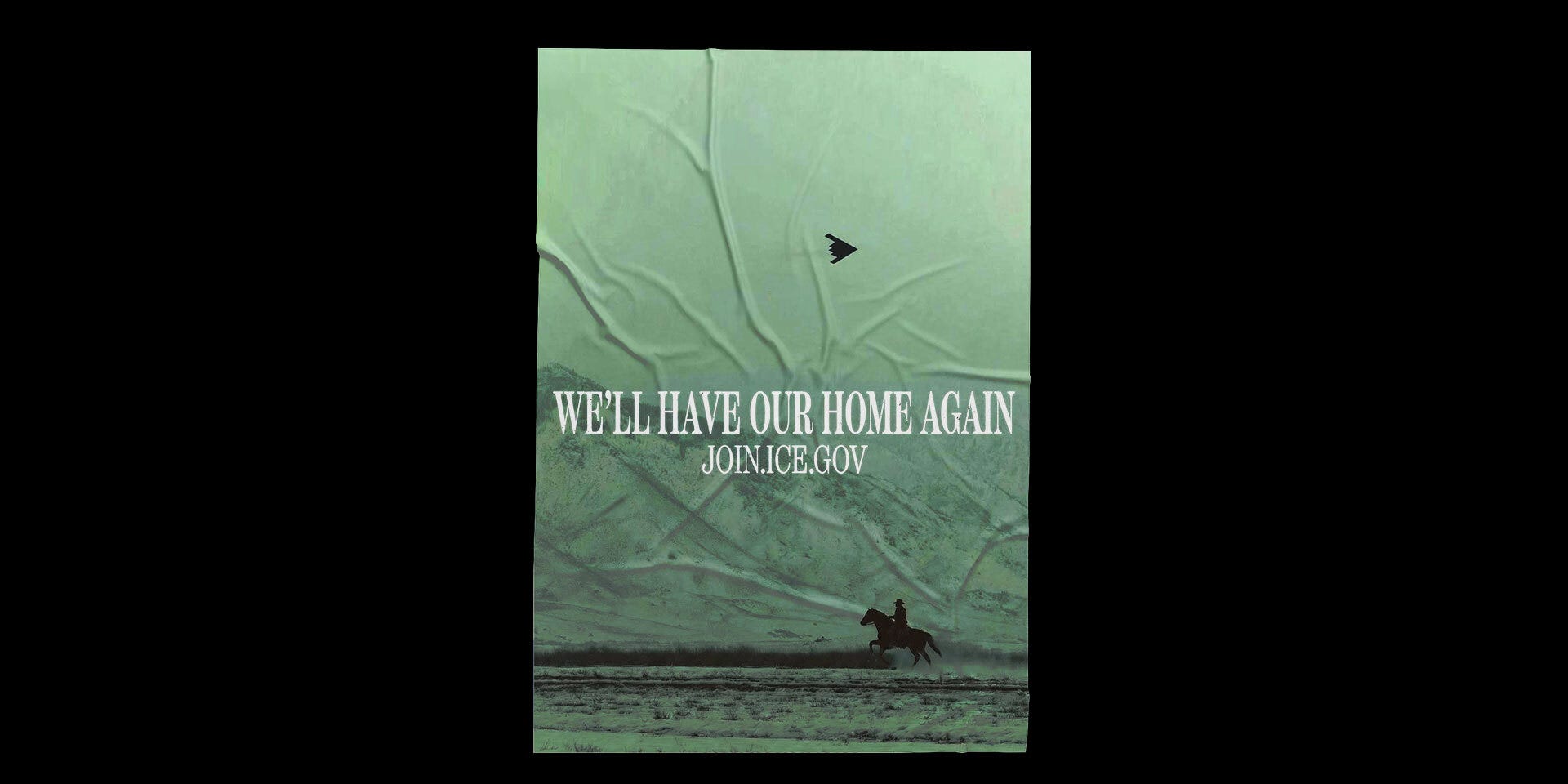
In John Gast’s 1872 painting American Progress, settlers ride out West over the grasslands on horseback and caravan and railroad car, driving the primitives further into the cramped and fetid darkness on the left of the frame. The settlers bring the light with them. Colombia, blonde hair loosed down her back, drifts gauzily in white above the scene. She holds a school book in one hand and the unlaced end of a telegraph wire in the other. The ‘star of empire’ is pressed into her forehead. This painting was used in Immigration and Customs Recruitment ads, captioned with the slogan: “A Heritage to Be Proud Of, a Homeland Worth Defending”.
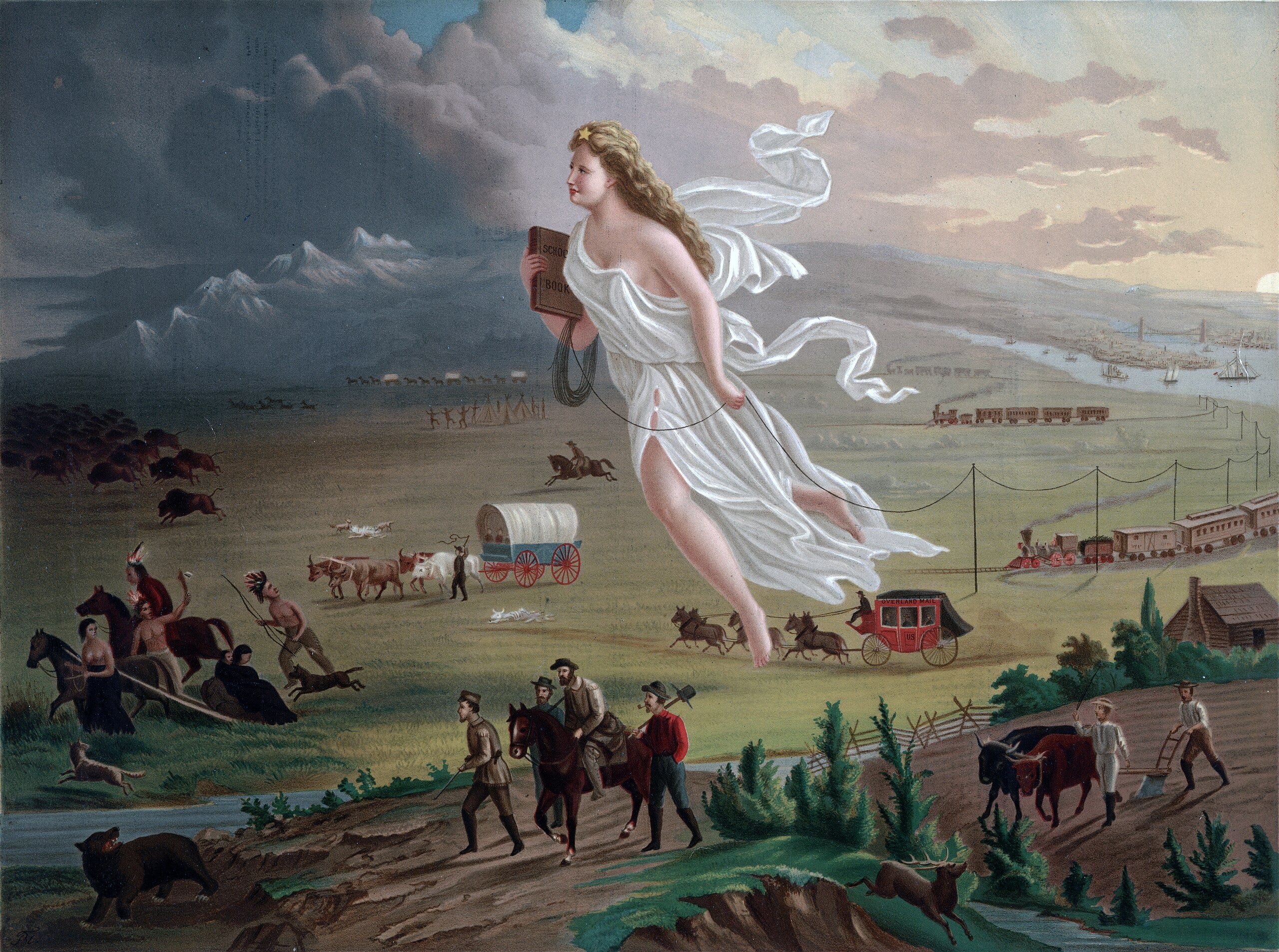
Earlier this month, both the White House and the Department of Homeland Security posted another recruitment ad. It showed a cowboy on horseback silhouetted against snowy mountains, as a military jet flies above. This caption reads “We’ll have our home again”, a line with an uncanny similarity to the title of a song by The Pine Tree Riots. The 2023 song is popular amongst sections of the far right such the Proud Boys (once notorious for their tiki torches, now notorious for their uniforms).
“In our own towns, we’re foreigners now
Our names are spat and cursed
The headline smack, of another attack
Not the last, and not the worst
Oh my fathers, they look down on me
I wonder what they feel
To see their noble sons driven down beneath a cowards heel
Oh by God we’ll have our home again
By God we’ll have our home
By blood or sweat, we’ll get there yet
By God we’ll have our home”
X
Spectacular media violence does two things very well. The first: Determining who can be safely to commit violence morally, outside of the guidance of state directive. The violence of the state can be both practically strengthened and morally redeemed through stochastic gesture. The second: Defining the bounds of bare life - determining those to whom any outrage can be done, must be done, to protect the legitimate subject; the good citizen, the innocent, the upstanding instutition, the racial in-group, etc. In other words, necropolitical culturemaking brokers the difference between the mutually dependent categories of the outlaw and the criminal.
X
It is by no coincidence that the outlaw of frontiersman cultural imaginary is such a close cousin of the rebel cop. They both deploy violence liberally in the name of an abstract form of justice, peacekeeping, lawandorder, etc, that has a necessarily slippery and notional relationship to legality as a formalised. It’s not a a series of civil conventions underwritten by governmental procedure and enforced through the violence of policing and prisons. This is lawandorder aa associative, homeopathic moral magic. It’s in this this wily, janus-faced mode that the outlaw exists. They can break the particular laws without being cast in the category of the criminal. They can lay the law aside gently, for its own safety, without shattering it. They may trample on a few procedures, but goddammit they don’t do things by the book when there are lives on the line, bad guys out there waiting to pounce. Are we really going to expect them to wade through the fussy prescriptions of a stolid, unresponsive, decadent, distant state? Or are we going to stand out of the way and let them get the job done?
x
Often the romantic outlaw - the frontiersman, the rebel cop, the cowboy - is framed as an archangel of libertarianism, the avatar of politics which repudiates the centalised state in favour of natural justice emergent out of the hearts of the individual in contention with the raw state of nature. The violent domination of the government is intolerable, but individual souls are free to take a swing at violently dominating one another on a private, piecemeal basis. May the best man win. This account is not strictly untrue - but it does miss a trick.
Few would honestly want the life of the workaday frontiersman - broken backs and desperate winters and a litany of options for a cruel, early death. That is to say: like any playground libertarianism, this romance thrives on artifice, on remaining fantastic and unfulfilled. You may choose to indulge the idea of escape from the petty dominations of society in favour of a rollicking gunslinging freedom. You may only do so safely from within the bounds of social comfort and state mercy.
It may not be the worst of its sins, but there’s something childish and grossly libidinal about this form of politics. They experience as oppression the failure to have their particular orientations towards violence endlessly coddled and vindicated by the nation they have psychosexually glommed onto by their suckers. This politics does not crave liberation from government domination. Rather, it craves the ability to be numbered among the righteous, those who can shoot first and think later, knowing that when they act they do from a steadfast membership of in the polis of moral and political good. It is not about being spared from state terror - when were these people in danger of that? - but being able to participate in directing it at others, and being insulated from any consequence. They do not want to be free from the state, they want to be the state .
X
One’s ability to indulge the idea that the government is in theory engaged in illegitimate domination but not through things so gauche or obvious as police, prisons or the military rests on your identification with those institutions. As gestapo fluffer and renowned bootlicker Tim Pool said of his defence of ICE agents: “I’m not licking the boot. It’s my boot. I voted for it. I’m the one stomping…”
X
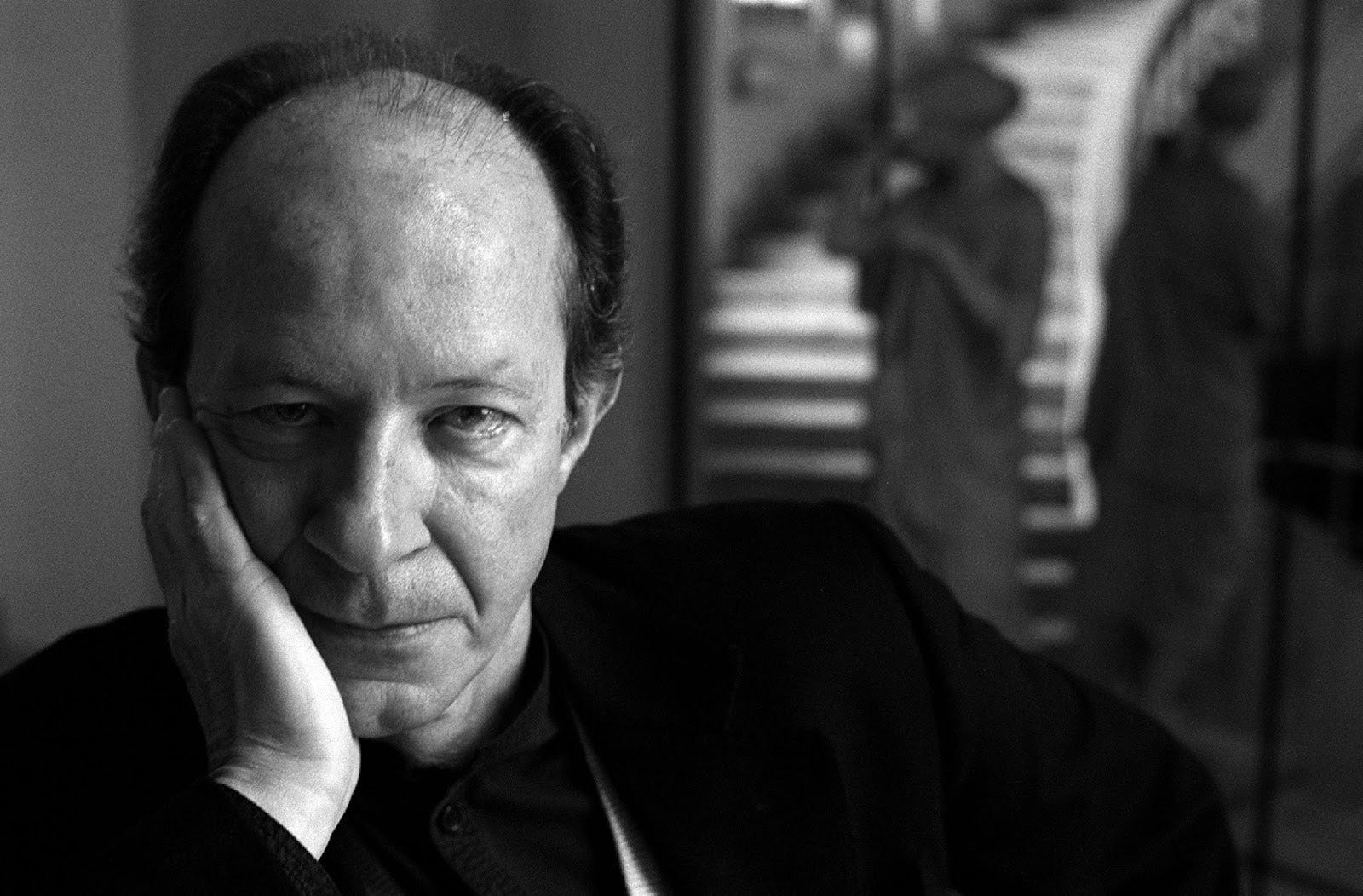
In Homo Sacer: Sovereign Power and Bare Life, philosopher and erstwhile sane person Giorgio Agamben dusts off the ancient Roman concept of the homo sacer (sacred man, sacrificial man, sacrificed man) to theorise that the state forms through a series of exclusions, testing and forging its power on its ability to create outlaws. Those banished from the civilised world and its protections, reduced to a state comparable to social death. Anything can be done to them, and anything must. Civilisation is imagined geographically; a citadel with walls raised around it to keep out the beasts. There’s some argument for drawing comparisons between this formulation of state power and the imaginaries of the Frontier - and indeed with Trumpian fascism. There are barbarians and beasts on the other side of the citadel, rustling in the veld, so - build that wall, go threshing in the long grass with your machete. But it’s curious that Agamben remains in the terrain of ancient legal theory when more contemporary history would furnish him with more instructive horrors. To whom can nearly any violence be committed and the perpetrator easily remain forgiven by the state - if forgiveness is even necessary? Think - the slave. The imprisoned. The criminal. The racial other both within and without - and their companion the race traitor. Latterly, the terrorist. Critically, with these examples there is no geographic split that sharply cleaves civilisation from wilderness. The state carves out a series of exceptions through the mechanisms of race, citizenship, class, carcerality, gender, political loyalty, etc. Bare life must often exist within the political interior, within the metropolis - because that is where its labour and its political utility is needed. Wherever the state finds it useful to maximally dispense with the artifices and procedures of rights or democratic order or other self-proclaimed organising principles of civilisation. there is bare life. Your own living room, your classroom, your workplace, your town. They make a wilderness where a wilderness is needed.
X
The outlaw has a permission the plain criminal does not - to return home, to expect forgiveness, to expect mercy, to enjoy sympathy and even envy, to step beyond the bounds of the legal consequence without abandoning its protections. To never be stripped of morality or their right to engage in self-defence. The right for their violence to mean things, for it to contain political or moral insight that demands change, rather than proof of brute criminality that requires further crackdowns. The state is justified, redeemed and reinforced through the outlaw, the outlaw can experiment in violence knowing that they will ultimately be spared.
X
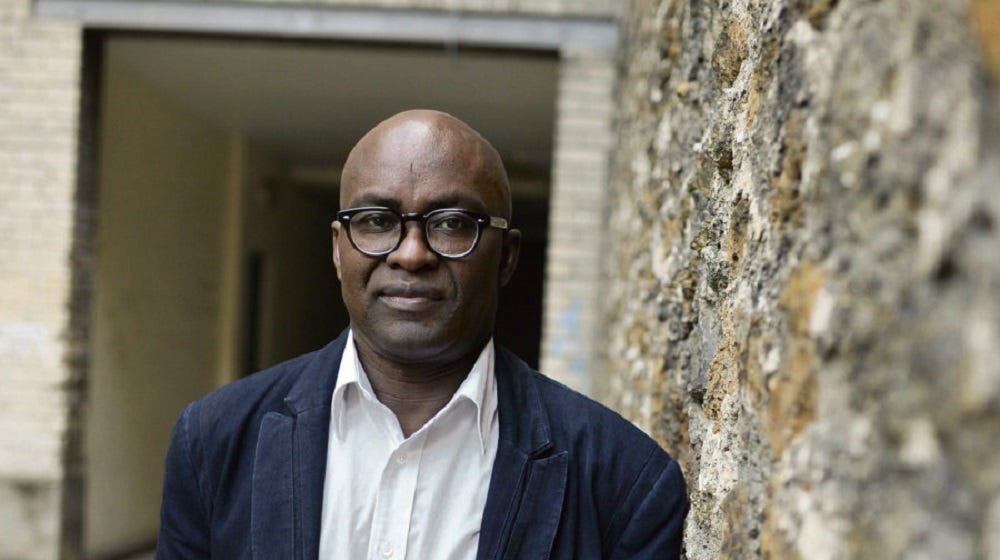
Achille Mbembe has written that the state requires non-state actors to constitute and reinforce its power. Stochastic and official violence rely on one another to create mutually strengthening compacts of social violence. The state has a monopoly on legitimate violence; and like many monopolies, acts through a series of sub-contractors and shell corporations through which it can disclaim liability.
Furthermore, the outlaw promises to provide a disciplinary function for a state tending towards corruption, and a crucible of quasi-democratic authenticity. Their social violence is the cry of the common clay; the primal act of morality is the you that Uncle Sam needs shooting an invader dead on the doorstep as their bride and child quiver behind them. The romance of violence in service of moral unquestionables that the state claims to be stepping in to support, regularise and scale. The permissible and the mandatory, entangled.
X
The state may be constituted through the outlaw - but not in Agamben’s sense. The outlaw in this sense is the outrider, the forerunner, the experimental and sacrificial and flexible node of normative violence. In 2020, Teenage gunman Kyle Rittenhouse drove across state lines with the express purpose of mowing down BLM protesters. He shot three unarmed people, two of them fatally. He was acquitted on basis of self defence and walked free. Before loading his rifles into the back of his mum’s car, Rittenhouse had been on a junior police training programme. In some ways his fatal error was being too keen a sign on.
Now in 2026, ICE are gunning down protesters, dragging migrants and suspected migrants off to internment, disappearance and death. They will not answer to a court of law - they are the law.
X

At this point it’s an eyewatering understatement to point out that Immigration and Customs Enforcement Officers are not staying primly within the bounds of legality. Their obvious - and sometimes triumphant - flouting of the law has not prevented many politicians, pundits, observers from saying that Twin Cities protesters should stay out of the way of law enforcement, that those targeted by ICE should stay pliant, comply. Let’s not participate in the flaccid, self-congratulatory outrage of liberalism. Law is itself a tool of domination, legality gives us little to no information about what is good and what is bad. If you bundle someone into the back of a van and cram them into a concentration camp, it does not matter if the paperwork was in order. Nonetheless it’s coldly fascinating to see just how flexible the concept of enforcing the law, of lawandorder can be in the context of extraordinary violence. Right and legality and moral authority flow from the opposition to the category of criminal, from the capacity for force.
The category of criminal is similarly hot and mobile. Let’s rehearse the obvious - most people at risk of kidnapping do not have criminal records. If they did that would not justify being menaced and deported. Protesting is legal, open carry of firearms is legal; confronting an officer is supposedly not a capital offence. When ICE and its cheerleaders label people criminals they’re not really pointing towards a formal, finicky relationship to actually-existing law. It’s a gesture of moral ontology that readies them for any kind of violent treatment - up to and including death.
X
At the base of these outrages is the carceral precept that it is possible for people to deserve being murdered by the state, that it is your duty as a citizen to avoid earning that kind of fate.
X
Footage of Black Twin Cities residents carrying firearms to protests was met with outrage. It was taken by many on the right as further proof of Minnesotan anarchy and social breakdown, further proof of the grim necessity of ICE guns raised to meet it, ICE tanks blockading sidewalks and ICE boots breaking down the doors of homes and workplaces. It is hypocritical, yes - and it is also honest. The white supremacist state does not feel able to safely deputise armed Black protesters to commit the kind of violence that coheres with or reinforces structures of discipline and accumulation. That they are obeying the law does not matter - they are still criminals, readied for death.
X
“I’m the one stomping”- It’s a rather neat admission that whiteness and the squalid psychic rewards of fascism have corralled your loyalties to big father nation so successfully. You feel entangled, you do not desire freedom from the state but a chance to share in its founding violence. You want the assurance that whatever is coming, you will be spared.